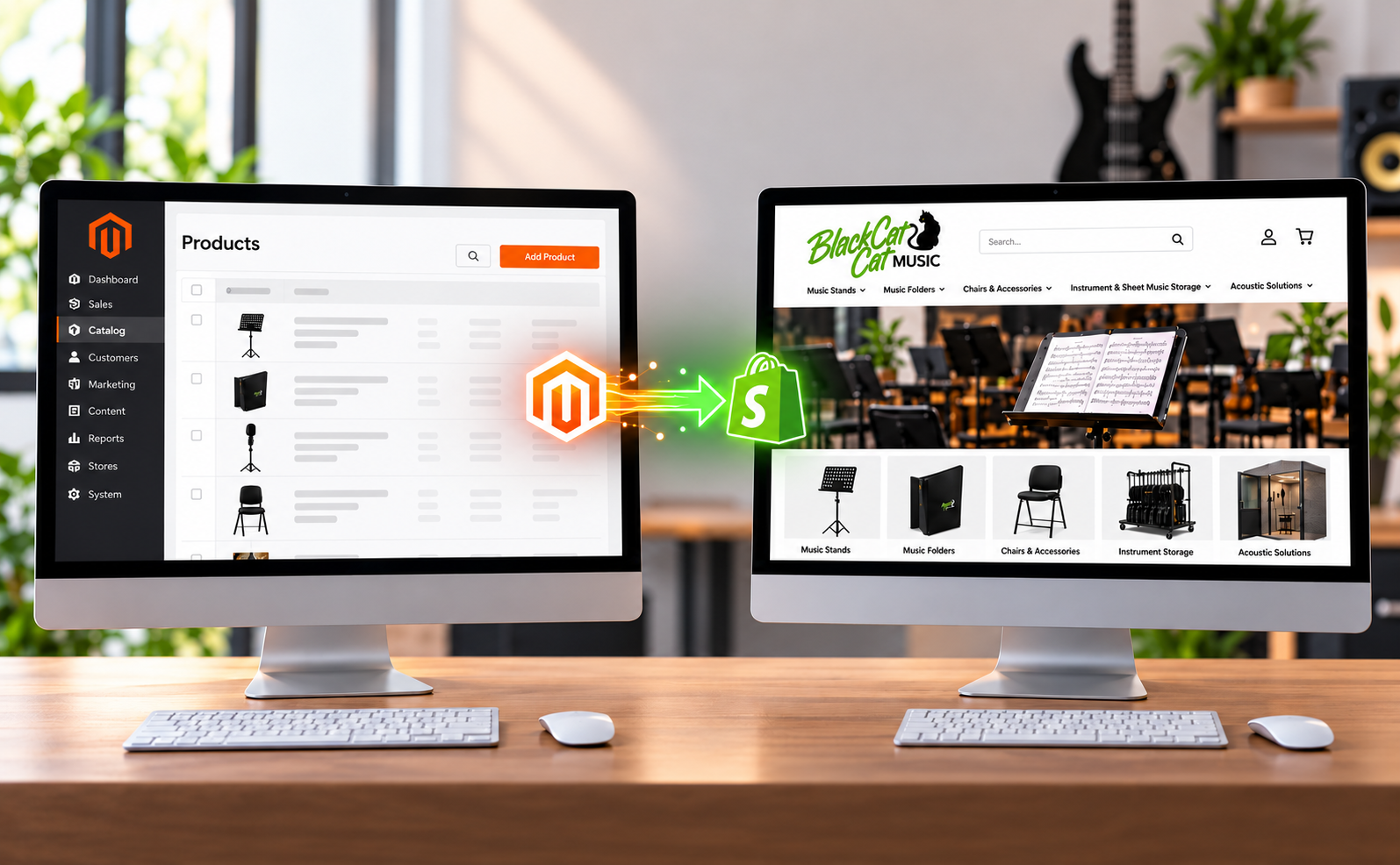
How chillicommerce Migrated Black Cat Music from Magento to Shopify
Every business outgrows its website at some point. Running two stores is difficult, especially on a platform that no longer fits your business.
That was the challenge Black Cat Music, a UK supplier of specialist equipment for music performance and education, was actually facing. The business sells to customers in the UK and in Germany. Its website had been built on Magento with a multi-store setup, and it had served the business well for a long time.
But things changed. The business wanted a new look. It wanted a simpler way to manage the store and each market to have a buying experience that made sense for its customers.
This is where a Magento to Shopify migration made sense. But moving the store was only one part of the project. The site also had to follow a new design and work for two markets.
The challenge behind the Magento to Shopify migration
On the surface, the job sounds simple. Move a website from one platform to another. In reality, it was a bit more than that. The old Magento site used multiple stores, and Shopify works differently. It uses one store, and you can add different markets inside it. So copying things across was not an option. chillicommerce had to rethink how the whole site was organised.
On top of that, the UK and German customers did not need the same thing. They needed different domains, different languages and, in some cases, different ways to buy. And all of this had to look right on a brand new design.
When people evaluate Magento migration services, they just focus on moving the site. But the planning and setup are just as important. They decide how well the new store runs.
What the Magento to Shopify project covered
The project covered a lot more than moving products from one platform to another. Here is a closer look at each part of the work, from the store structure to the product pages.
Bringing the multi-store setup into one Shopify store
The first job was to sort out the structure. Magento had been running several stores side by side. On Shopify, all of that is now present in a single store. The UK and Germany are set up as separate markets inside it.
- The UK market runs on the .co.uk domain.
- The German market runs on the .com domain.
Each market has its own dedicated domain, so customers land on the address they expect. But the team does not have to manage two websites. Products, orders and content are looked after from one admin.
For a business that sells in two countries, this makes everyday work a lot simpler. There is less switching between stores and fewer places where things can go out of sync.
Language support for both markets
Language was set up alongside the markets. English is the main language of the store. For the German market, Dutch has been added too. This means customers in that market can use the site in a language that suits them. It is a small detail, but it has a big effect. People are more likely to buy when a website feels made for them.
Moving the Magento data across
A new store is only useful if the information comes with it. All the existing Magento data was migrated to Shopify. This covered the essential website and store information the business needs to keep running. Magento and Shopify do not hold data in the same way. So this was never a simple copy and paste. Each part had to be checked and placed correctly in its new store.
The benefit is that the team did not have to start from scratch. They moved into the new store with their information already in place.
Planning to move from Magento to Shopify?
Get a clear plan for moving your store without any hassle.
Book a Consultation
Recreating the website on Shopify
The website was recreated on Shopify, not just moved over. The original Magento content and store structure were the starting point. They were then adapted to fit Shopify’s single-store, multi-market setup. The content is all still there, but it is now organised in a way that suits the new platform.
This matters more than people expect. A site that is moved without being reshaped often feels awkward on its new platform. Adapting it from the start avoids that.
A custom theme built on the approved design
Black Cat Music had a new design ready before the project began. The next step was to turn it into a working Shopify store. The Shopify theme was customised to follow the design. Each page was developed and styled to match the approved layouts. The finished site looks like the design the business signed off on, not a rough version of it.
This is the difference between installing a theme and building one. An off-the-shelf theme gives you a layout. A customised theme gives you your own.
Add to Cart and Add to Quote
The UK and German markets do not buy in the same way, so the store does not treat them the same.
- In the UK, customers get the standard Add to Cart option.
- In Germany, customers get Add to Quote as well as Add to Cart.
This supports the specific purchasing needs of the German market. A customer who is ready to buy can add the product to the cart. A customer who wants a quote first can ask for one on the site. Shopify does not offer this as standard, so it was built as custom functionality. The result is a store where each market gets the buying journey that suits it.
More choice on the product page
The product pages were also customised to support multiple gold blocking options. Customers can now choose the option they want while they shop. They are no longer stuck with one fixed choice, so they have more flexibility when selecting a product configuration.
This is a good example of where custom work helps. Shopify gives a strong base, but some products need extra options. Building them into the product page keeps the buying process simple for the customer.
The results after moving to Shopify
Black Cat Music has moved from Magento to Shopify with a store that fits the way the business works.
- Store management is now in one place.
- Each market has its own domain and its own buying experience.
- Language support is in place for both markets.
- Product options give customers more choice.
The project delivered a redesigned and market-specific ecommerce experience. It comes with centralised store management, multilingual support, custom purchasing workflows and better product customisation.
For Black Cat Music, chillicommerce delivered more than a new website
As a Shopify agency in London, our job was to build a store that matched the way the business sells. The team now manages everything from one place. Each market has its own domain, language and buying options. And the site looks the way the business planned.
This is what a good migration should do. It is not just about changing platforms. It is about making the store easier to run and easier to buy from.