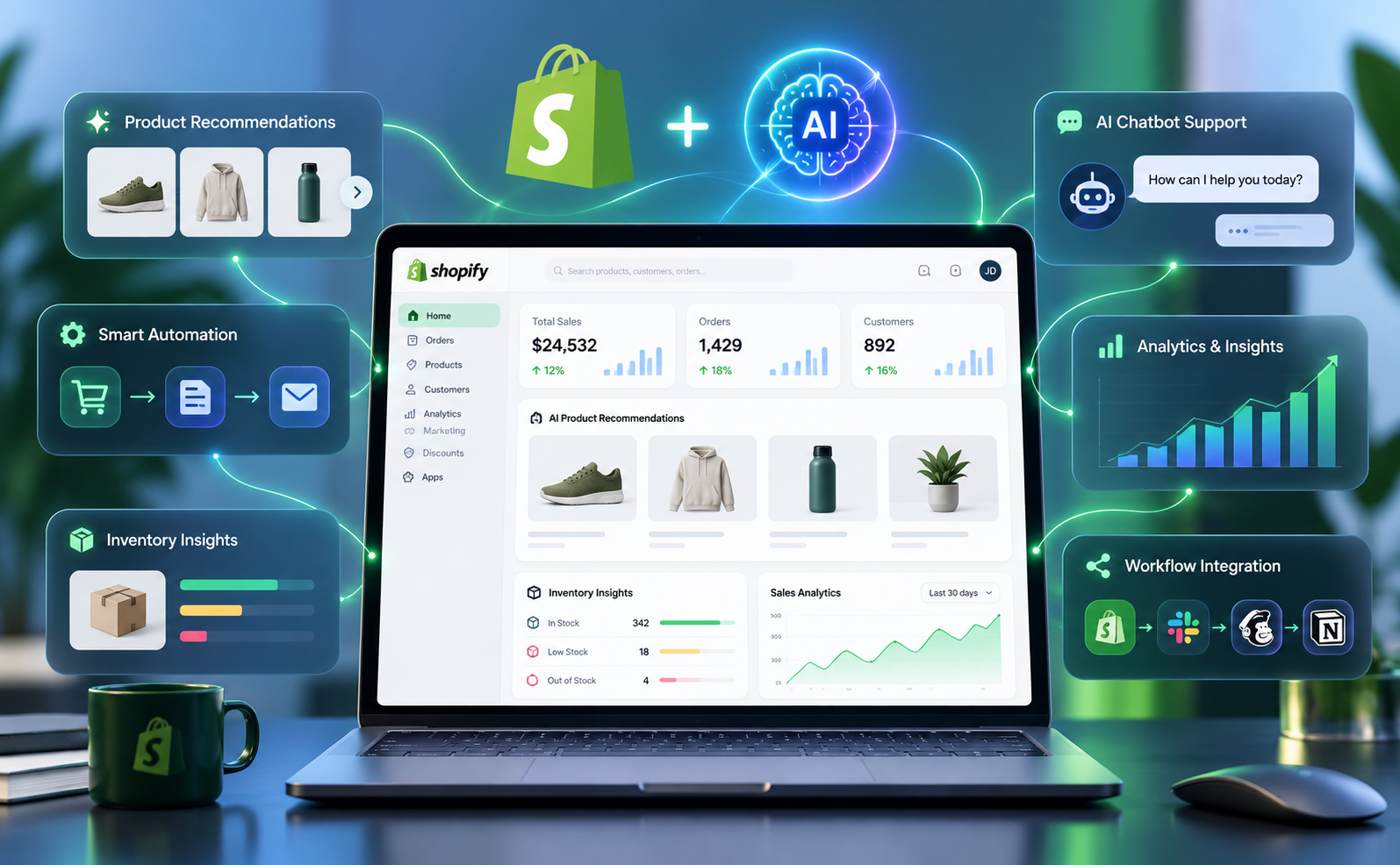
What are the Key Features of Shopify AI Integration in 2026?
Platforms like Shopify now support artificial intelligence in their functionality, helping merchants achieve more with less effort. Using AI’s potential has changed how merchants search, support, sell, and make business decisions.
It has streamlined business operations like writing product descriptions, answering the same shipping question for the fiftieth time, and forecasting next inventory levels. Simply adding AI to your Shopify store isn’t enough. The right Shopify AI integration connects machine learning tools to the store’s data and automates and personalises the shopping experience.
Artificial intelligence adds a layer to your store development process and customises the overall shopping experience. If you are planning an AI-powered Shopify development, this guide shares some must-have features to fit into your online store.
Must-Have Features of a Shopify AI Integration in 2026
Simply adding AI isn’t enough for your Shopify store; you need to understand what it can do. The right implementation of AI not only eliminates repetitive work; it uses your own data and helps customers find what they are looking for.
Here is a list of features that your Shopify store should include for the best use of AI:
Product discovery adapting to users
Your store shouldn’t show the same thing to every visitor. Integrating AI into a Shopify store allows you to provide visitors with customised recommendations and product suggestions based on user behaviour, purchase patterns, etc. The general keyword-based searches are replaced with intent-based results, making product discovery adaptive to each shopper.
AI-powered Customer Support
Often, customer queries are about delivery times, replacements or returns, order status, etc. AI chat assistants can answer these queries using genuine policies, live order data, and other related information. They can transfer to human support assistants when required.
Inventory management
Overstocking holds up cash, and stock shortages potentially lose sales. Integrating AI gives you the middle ground. You can ask a Shopify development company to design a store backed with AI that can analyse sales history, seasonality, and lead times to indicate what to reorder and when. A heads-up before a best-selling product runs out can save you from huge losses.
Structured marketing campaigns
Instead of sending the same email to everyone, AI can group customers based on buying history and behaviour. And further send the right messages at the right time, including basket reminders or reorders.
Connect with existing systems
You can connect your existing store to your ERP, email platform, payment, shipping tools, and other third-party systems for simplified management. This adds necessary functionality to your store itself and syncs everything.
Product descriptions and content
Integrating AI simplifies writing product descriptions, titles, meta tags, and email copy in your brand voice. If your Shopify store has a large catalogue, you can draft content and descriptions and optimise later on.
Dynamic Pricing
AI can use your data, demand, competitor pricing, stock levels, and buying behaviour to adjust prices and offers. This protects your margins during quiet periods and busy ones.
Orders and returns automation
Simple operations like order confirmations, shipping updates, return requests, and refund processing can be automated, saving your support team time and eliminating manual errors.
Why Should Your Business Invest in Shopify AI Integration?
Even after evaluating the features, it is important to find out why your business should actually invest in a Shopify store backed by AI.
Eliminates repetitive operations
Your ecommerce team is still performing activities that AI can do on their behalf. Investing in AI-powered stores would let them focus on strategy, supplier relationships, and growth.
Higher conversions
When the store feels relevant to every shopper, the conversion rate increases. AI offers a personalised experience to your users, increasing the overall conversion rate.
Better customer experience
Customers expect quick answers even when you aren’t around. With AI integration, you can provide faster responses and elevate the overall customer experience.
Ready to Bring AI into Your Shopify Store?
Learn where AI can make the biggest difference to your business.
Book a Consultation
Lower operating costs
When you cut down on manual tasks, it eliminates wasted stock and lowers support costs. When used correctly, AI can lower your business operating costs up to a certain extent.
Data-led decisions
Using AI gets you clear insight into what sells and what doesn’t. This helps with overall planning, buying, and marketing accuracy.
How to Plan a Shopify AI Integration: A Practical Roadmap
Now that you have decided to invest in a Shopify store powered by artificial intelligence, here is how to do it correctly:
Start with one problem
Evaluate where your team loses the most time and what problem AI integration can solve. It can be repetitive support emails, an unstructured catalogue, or abandoned baskets. You need to pick one and decide what you want to fix with AI integration first.
Analyse your data
Unorganised data, inconsistent stock counts, duplicate records, etc., often reflect in the outcomes. Thus, before you get AI capabilities integrated into your Shopify store, make sure to tidy up your data and optimise it correctly.
Decide what to build
You can get certain functionalities integrated, while the rest is built from scratch. Evaluate each category to understand what needs to be built and what can be simply fixed using third-party integrations.
Test on one product category
An experienced ecommerce development company in London would first test the store on a product category. Compare the results with current numbers to see whether the market is accepting the change.
Measure and adjust
Tracking response times, conversion rates, average order value, return rates, hours saved, etc., can help you make necessary changes and use AI optimally.
Conclusion!
AI-backed Shopify stores can not only elevate the customer experience, but also eliminate manual operations, manage inventory, and answer customers outside business hours. Adding AI at every step of your store development is not essential; you need to partner with the right AI automation agency and let them find where AI can add value to your Shopify store.
FAQs
How much does it cost to add AI to a Shopify store?
It depends on what you need from your Shopify store. If you are looking for something customised to your business, then it would roughly range from £5,000 to £50,000+. When your store requires complex features and integrations, it falls on the higher side of the price range.
How long does Shopify AI integration take?
If you have a custom Shopify store idea for your business, it might take around 4 to 10 weeks of time, based on what functionality you would want to add.
Can I use AI with my current Shopify theme and apps?
Yes. AI can be used with your existing Shopify theme and apps in the majority of cases. However, you can get your store analysed, and the developers can help you with the right solutions.
How to choose the right Shopify development agency?
To hire the right Shopify development company, look for real Shopify experience, pricing structure, portfolio, industry experience, communication channel, security practices, and most importantly, AI integration expertise.